NDWaveletTransforms.jl
NDWaveletTransforms computes discrete wavelet transforms of arrays with any number of dimensions and a separate number of levels along each axis.
An l-level transform is supported on an axis of length n whenever 2^l divides n; it need not be a power of two.
Example
using NDWaveletTransforms

x = rand(128, 128)
y = dwt(x, WT_D4, 2)      # copy, two levels along each axis
idwt!(y, WT_D4, 2)
x ≈ y                     # true to machine precision
dwt returns a copy; dwt! transforms in-place and returns its argument. The level argument is an Int for the same number along every axis, or a tuple for a separate number per axis:
dwt(x, WT_D4, (1, 3)) # one level along axis 1, three along axis 2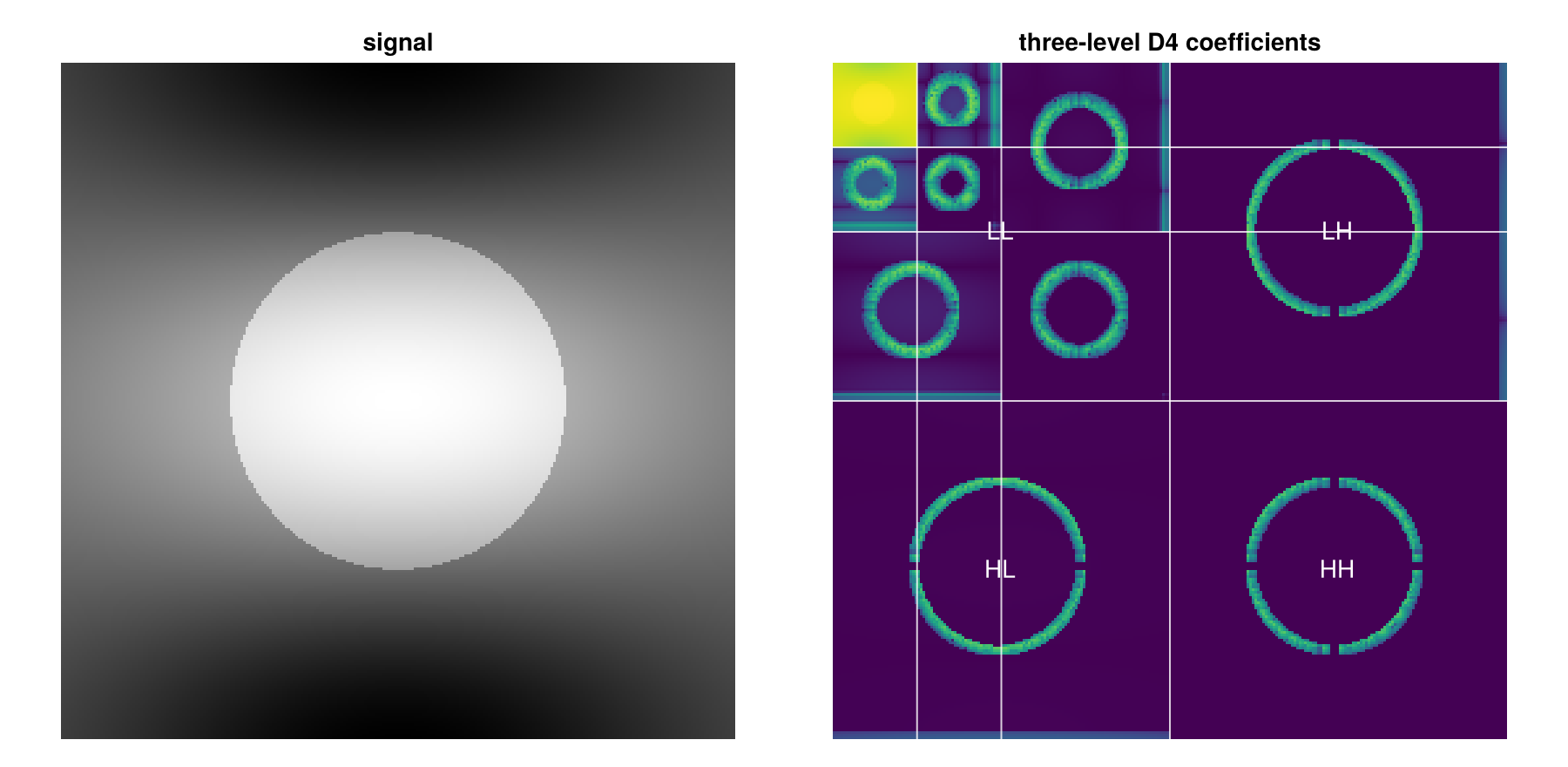
Transform types
Standard, nonstandard, and packet transforms are supported. Transforms are indicated by name. A standard transform recurses on the approximation band; a wavelet packet transform recurses on every subband. A nonstandard transform applies every level along one axis before moving to the next, where the standard form advances one level along every axis in turn; the two agree at a single level.
| standard | wavelet packet | |
|---|---|---|
| separable | dwt / dwt! | wpt / wpt! |
| nonstandard | nsdwt / nsdwt! | nswpt / nswpt! |
The inverses are idwt, iwpt, nsidwt and nsiwpt.
The convention keyword selects the phase of the detail coefficients; see Phase conventions.
Denoising and compression
Coefficients can be shrunk before inverting. denoise estimates noise from the finest detail band, thresholds those coefficients, and inverts. compress instead keeps a fraction of the coefficients. See Algorithms for details.
clean = denoise(noisy, WT_D4, 4)
small = compress(image, WT_D4, 3; keep = 0.05)
Transforms on-GPU
Transforms are also implemented for GPU via KernelAbstractions.jl. To perform an on-GPU transform, pass a GPU array. All flavours of transform are implemented.
using CUDA
g = CuArray(rand(Float32, 1024, 1024))
y = dwt(g, WT_D4, 3)